Discover Secondary Math & Science Resources
Here you’ll find my products that are available at teacherspayteachers.com in my store.
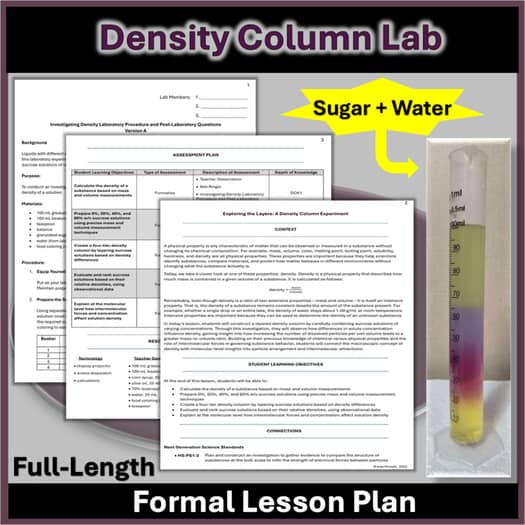
Sugar Solution Density Column Lab Formal Lesson Plan
Bridge the gap between molecular concepts and real-world observations with this engaging laboratory experiment in which students create a density column using different concentrations of sugar solutions.
Target Classroom
I created this lesson for a secondary-level chemistry class.
Lesson Duration
This lesson is designed for a 55-minute class session but can be easily extended. Included discussion questions in the lesson plan offer flexibility to support deeper exploration during longer sessions.
Included Resources
- For the Instructor:
- Formal Evaluation-Quality Full-Length Lesson Plan
- PowerPoint Slide of Bell Ringer Followed by a Solution Slide (for convenient projection)
- Sample Solutions to Post-Laboratory Questions
- For Students:
- Detailed, Easy-to-Follow Investigating Density Laboratory Procedure and Post-Laboratory Questions (two versions to facilitate differentiation for on-grade level learners and higher-ability learners)
Key Features and Benefits
- Complete, Full-Length Lesson Plan – The detailed, start-to-finish lesson plan guides instructors through the lesson, supporting high-quality instruction.
- Standards Aligned – This lesson is intentionally designed to support the Next Generation Science Standards.
- Differentiated Instruction – Although all students engage with the same core concepts and pursue the same learning objectives, this resource contains two differentiated sets of lab instructions and accompanying post-laboratory questions designed to support on-grade level learners and advanced learners. Each version maintains rigor while varying complexity and scaffolding.
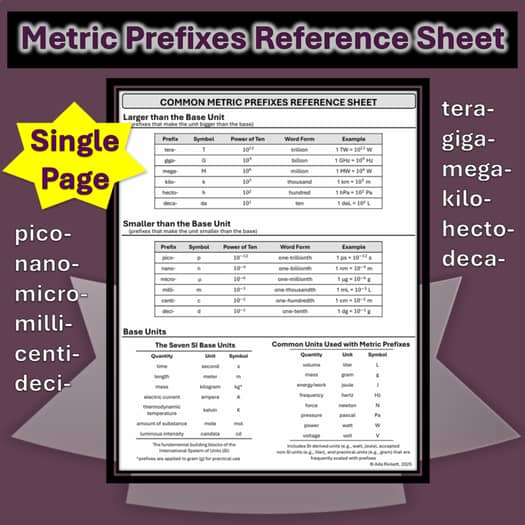
One Page Metric Prefix Reference Sheet for Unit Conversion
This organized, single-sided reference sheet displays twelve common metric prefixes, the seven International System of Units (SI) base units, and frequently-used base units in science disciplines.
This handy resource is designed to give students a concise, visually-organized reference that is easy to read at a glance so learners can focus on performing unit conversions and solving problems rather than flipping through pages. It is ready to print and distribute as a handout or binder insert.
Perfect for math or science students, teachers, and tutors who want an organized layout designed for fast referencing during study sessions, homework or exams!
Key Features
This visually-enhanced formula sheet is intentionally designed for ease of use, making quick reference efficient, seamless, and student friendly.
- Included Metric Prefixes (larger than the base unit)
- tera-, giga-, mega-, kilo-, hecto-, deca-
- Included Metric Prefixes (smaller than the base unit)
- pico-, nano-, micro-, milli-, centi-, deci-
- Included SI Base Units
- second, meter, kilogram, ampere, kelvin, mole, candela
- Included Common Units Used with Metric Prefixes
- liter, gram, joule, hertz, newton, pascal, watt, volt
Supports Common Core Standards
By high school, students should be able to fluently apply metric prefixes in science and math contexts.
Because these standards require students to fluently use SI units and prefixes when modeling real-world problems, this resource supports the following Common Core State Standards for High School – Number and Quantity:
- HS.N-Q.A.1 – Use units as a way to understand problems and to guide the solution of multi-step problems; choose an interpret units consistently in formulas; choose an interpret the scale and the origin in graphs and data displays
- HS.N-Q.A.2 – Define appropriate quantities for the purpose of descriptive modeling
It also supports the Next Generation Science Standards (NGSS) Crosscutting Concept of Sale, Proportion, and Quantity.